Who has access?
An alternative settlement service can be available to a narrow group or broadly accessible. That design choice affects which trading relationships can move to it.

A payment instrument depends on people and institutions willing to keep accepting, exchanging and settling it. What keeps that infrastructure in place?
My PhD research in monetary economics studies that question with agent-based models. It connects a long-standing interest in payments and financial technology with a more basic problem: how decentralized trade acquires the institutions it needs.
The starting point is a Howitt–Clower economy. Agents have trading needs, shops enter and exit, and a medium of exchange can emerge through their interactions. Introducing private settlement services or a stylized public digital rail changes the opportunities available to those agents. The model lets me follow the adjustment as institutions gain or lose the business that supports them.
Agents need ways to obtain goods and complete exchanges. Trading relationships give monetary services a role.
Entry and operating costs must be covered. Fees, transaction volume and access rules influence who can remain active.
Changing settlement options can alter the customers and revenues of existing intermediaries, with consequences for entry and exit.
Three vignettes that map to the conceptual steps above. They are honest illustrations of the mechanism, not outputs of any run.


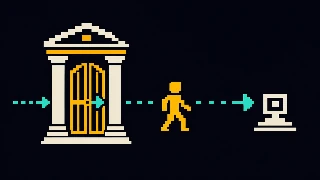
An alternative settlement service can be available to a narrow group or broadly accessible. That design choice affects which trading relationships can move to it.
A service's ability to process a transaction is only part of the question. Its operating costs and sources of revenue also shape whether it can persist.
An additional rail changes the environment for private intermediaries. I examine infrastructure survival and participation as the economy adjusts.
My published work also covers digital-currency energy use, decentralization, quantum computing and financial regulation. For a hands-on introduction to modeling, the simulations page starts with a two-agent exchange economy.